Where value pools
The Standards Stack — Post 3 of 8. Certified carbon intensity earns little premium today. So why are the businesses in data, certification, exchanges, capital moving so quickly and and placing bets?

Ask a trading desk or a supply and marketing team what a certificate of carbon intensity is worth today and most will give you a short answer: nothing. No premium, or a few basis points if you are lucky and the counterparty is European or Japanese. I have had that conversation many times over the past year, and in gas the answer has barely moved.
Then look at what is happening around them. Industrial software firms — Context Labs and Cognite among them — are building measurement systems that produce high-trust, batch-level carbon intensity for fuels or materials from real time production and operational data. Price-reporting agencies — e.g. S&P Global Platts and Argus — are folding carbon intensity into their assessments. Exchanges and registries — Xpansiv and registry operators such as Evident — keep emerging and rebuilding the plumbing for attribute trading. Certification schemes — OGMP 2.0, ISCC, CertifHy — are being written into regulation. None of these organisations are naïve and, while many would certainly like one, none of them are waiting for a carbon intensity premium — because none of them are selling the commodity.
Both things are true at once, and reconciling them is the point of this piece.
The thing is, the premium is the wrong thing to measure. Certified carbon intensity is becoming a condition of sale, not a surcharge on it — and the value it creates is captured almost entirely by the businesses around the number, not by the molecule or material itself. Premia are beginning to appear at the edges — European green steel and low-carbon aluminium both carry published differentials now — but they follow the compliance price rather than lead it and, for now, they remain the exception.
The premium is the wrong question
Here is the reframe. When a carbon-intensity specification becomes a prequalification requirement in a tender, the economics stop being about price and start being about access. If you cannot produce the CI certificate, your revenue on that contract is not lower — it is zero. If you can, you compete for the whole thing. The value of the certificate is the option to bid at all, which is to say the entire contract margin you would otherwise have forfeited.
Think of this: nobody pays a premium for meeting a sulphur specification, or a Wobbe index band for pipeline gas, or the LME Grade A purity standard for copper cathode. You simply cannot sell without it. Certified carbon intensity is on its way to becoming the same kind of thing — a licence to bid.
Once you see it through this lens and look for it, the evidence is not subtle.
Volvo Cars contracted near-zero-emissions steel from SSAB for serial production; Mercedes-Benz, Porsche and Scania signed offtakes with Stegra’s hydrogen-based plant. Those were won on specification. Meta has run tenders for certified low-methane gas to cover the upstream emissions of its data-centre power — a buyer with no direct regulatory obligation writing an intensity requirement into a purchase order. Public buyers are doing it by rule: Buy Clean California has required facility-specific, third-party-verified environmental declarations beating a maximum global-warming-potential limit since the start of 2025, and that limit ratchets down.
And the EU’s border tariff (CBAM) has quietly made intensity a matter of arithmetic. Because of how the mechanism is designed, the relationship between the emissions intensity of imported goods and the importer’s certificate obligation is non-linear: analysis of hot-rolled coil suggests a reduction of roughly a tenth in emissions intensity can cut the certificate requirement by around a third. That is not a premium. It is avoided cost, it is calculable, and it accrues to whoever measured well. Steelmakers outside Europe are responding accordingly — Hyundai Steel has pointed to rising demand for carbon-reduced plate from European automakers as the tariff takes full effect, with exporters prioritising lower-carbon routes precisely to preserve market access. Across the globe, exporters to Europe of EU CBAM-covered commodities have been scrambling to get ready for this.
So demand is where the value is created. It shows up as revenue protected rather than revenue gained, which is why it is nearly invisible in any analysis hunting for a green premium.
Where the value is captured
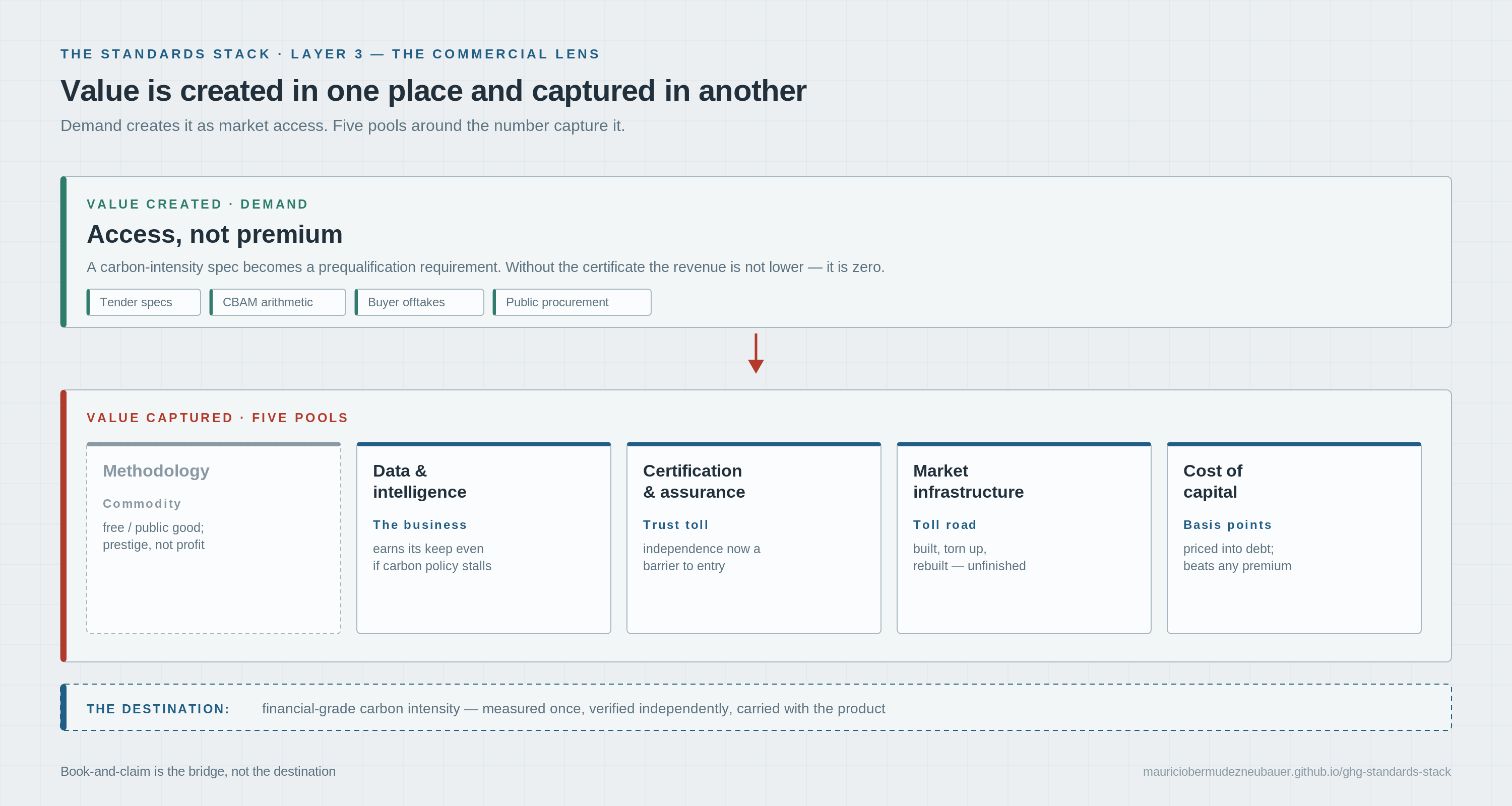
See the full Standards Stack diagram and details in my Github repo here.
Value created is not the same question as value captured, and conflating them is a mistake I see frequently. The producer captures market access. Almost everything else is captured by five pools sitting around the intensity number.
Three of them can be described quickly.
Methodology is a commodity. The frameworks themselves — the ISO standards, the GHG Protocol, the sector protocols — are free or nearly free, and the merger of ISO 14067 with the GHG Protocol’s product standard will push further in that direction. Owning the method confers enormous influence but little revenue — the EU’s own MRV framework is built substantially on OGMP 2.0, a protocol the industry developed and gave away. It is prestige, not profit, and that is broadly as it should be.
Certification and assurance is a trust toll — and it has just been handed a defensible moat. When the European Commission published its methane-regulation recommendations in July 2026, most commentary (including my own) saw only softened penalties. The more consequential detail sits underneath: certificate-based compliance is recognised for complex, commingled supply systems, and compliance providers are expected to be structurally independent of the industry they certify. Read against current operative policy rather than against the proposal and (as kindly pointed out to me by MiQ’s CEO Georges Tijbosch) that is a tightening — and it is regulation deciding who is allowed to collect this toll. Independence, in other words, has been converted from a virtue into a barrier to entry. Note what the Commission actually did: it published criteria, not names. Fourteen of them, covering certificate content, registry integrity, third-party audit and — the decisive one — that a provider be legally and functionally independent of any energy producer, supplier or importer, with separate accounts and no financial interest in the outcome. That single criterion disqualifies producer-affiliated certification in one go. Schemes already built to that specification are now publishing their own mappings against the criteria — MiQ has published its own assessment of compliance — while those that were not are likely reconsidering theirs. The timing sharpens it. EUMR reporting obligations began in 2025, verification requirements for importers arrive in 2027, and intensity limits follow in 2030 — but the binding constraint is not stringency, it is uncertainty. Firms can adapt to rules; what they cannot do is sign a fifteen-year supply contract while the interpretation of those rules is still moving. Certification is how that ambiguity gets converted into something a counterparty can underwrite.
Market infrastructure is a toll road, still under construction. I briefly covered the state of it in the last post — a daily methane-certificate benchmark launched and then withdrawn for thin liquidity, alongside block trades in the millions and a recent clearing arrangement between MiQ and CBL/Xpansiv. Registries and exchanges are where a mature attribute market would collect its rent. That market is not mature yet. The contrast with metals is instructive: price reporting agencies now publish standing low-carbon differentials for aluminium and green steel — Northern European green flat-rolled was assessed at a premium of roughly €100–170 a tonne early this year — because a compliance driver sits underneath them. Gas certificates have no equivalent, and no equivalent price.
The two remaining pools deserve longer.
Data and intelligence
This is the largest business in the stack, and the most defensible — but not for the reason usually given.
The obvious version of the argument is that somebody has to produce the number, and that producing it well requires instrumentation, sampling, engineering models and continuous data rather than some arithmetic of factors pulled from a database. True enough, and the gap between the two is wide: average emissions factors are, by definition, not measurements.
The stronger argument is that CI data has a second life. The same instrumentation that produces a measured and defensible carbon intensity figure — sensor data off compressors, flow and flare measurement, equipment-level process digital twins — is also an asset-optimisation dataset. It provides new lenses into production efficiency, predictive maintenance, prescriptive optimisation, and overall cheaper delivery of decarbonisation targets. I have watched operating teams request access to emissions data built for certification because it turned out to enhance the picture of how their plant actually runs.
That changes the investment case entirely. A business whose value depends on carbon policy holding its nerve is a fragile business. A business whose output improves plant performance and happens to produce a certifiable carbon number is not. If you are looking for where to build in this market, the test I would apply is whether the product would survive a decade of weak carbon prices. This pool passes it.
Cost of capital
The quiet one, and the pool most consistently underestimated.
Carbon performance is already priced into the cost of debt. Sustainability-linked loans and bonds tie margin to verified performance against agreed targets, with emissions the most commonly used indicator; the ratchets typically run in the range of 5–25 basis points either way. Trade-finance providers have begun offering concessions on cargoes backed by verified intensity certification.
Basis points sound trivial next to the promise of a green premium. They are not. A handful of basis points applied to billions of outstanding debt is a larger and far more reliable number than a per-tonne premium that, outside a few metals markets, mostly does not exist. It arrives annually, it compounds, and it does not depend on any counterparty agreeing to pay more for the same molecule. For a capital-intensive producer, this is currently the most bankable financial return on measuring well — which is a strange sentence to write about carbon, and a useful one to sit with.
The caution is real, though: these instruments have had a difficult few years, margin ratchets disappeared from parts of the market after some deserved criticism about weak targets, and the discipline now expected of the underlying metrics is considerably higher. That is a reason to expect the pool to reward credible measurement, not a reason to dismiss it.
The same logic is appearing on the risk-transfer side. Insurers have begun setting methane-management conditions for oil and gas underwriting — Chubb was the first major carrier to require leak detection and repair programmes of its upstream clients — and sustainability-linked policies tie premiums to verified performance, as in AXA’s programme with Enel. Note the direction of travel: the condition is about access to cover, not a discount on it. The same pattern as the tender.
Book-and-claim is a bridge, and electricity markets are the dry run
Most of what trades today is an unbundled attribute — a certificate separated from the physical molecule, sold on its own. It carries all the objections that have been levelled at renewable energy certificates (RECs), and it deserves some of them. Anyone who recalls the 2021 vogue for “carbon-neutral” LNG cargoes or “carbon-compensated” crude, where a hydrocarbon shipment acquired a green label through offset credits, should be wary of a market that separates claims from physical reality too casually. Regulators are now drawing that line themselves. The Commission’s July recommendations confirm that the methane regulation does not require physical tracing of molecules, deliveries or cargoes — meaning certificate-based compliance is acceptable — but only where certificates match the country of origin of gas actually imported into the EU. Global book-and-claim is out; origin-matched book-and-claim is in. That is a regulator specifying which version of the bridge will be allowed to bear weight.
But the useful thing about that comparison is that the power market has already run this experiment, and it is roughly a decade ahead of molecules.
Annual RECs attracted exactly this critique, and the response was not abandonment but a move towards granularity. EnergyTag now maintains a standard for hourly, time-stamped granular certificates, the first issuers have been accredited against it, and hourly matching underpins the 24/7 carbon-free energy goals that large electricity buyers like Google have set. The architecture did not change — it is still an unbundled attribute — but the claim became specific enough in time and place to overcome the most salient shortcomings of annual RECs.
That is the trajectory I would expect for molecules and materials: from annual averages, to supplier-level figures, to per-cargo and per-delivery certified intensity that a buyer can underwrite and an auditor can sign. The destination is not a certificate market. It is financial-grade carbon intensity — measured, recorded, verified independently, and carried with the product.
The convergence is already visible in a single buyer. A hyperscaler like Meta matching data-centre consumption hour by hour to carbon-free generation, while separately tendering for certified low-methane gas to cover the molecules that generate the rest, is doing both halves of this at once. Electrons and molecules, same problem, same direction of travel.
The honest ceiling
I should be straightforward about the limit of all this, because it is the strongest objection to my own argument and I made it myself in the last post.
Attribute certificates are, in an important sense, derivatives — of a carbon price, a tax, or any enforceable constraint on emissions. Where one of those sits underneath them, they can be valued, hedged and traded. Where one does not, a trader cannot price the option and will not pay for it — and that remains the condition across much of the world, including most of the region I now work in. Carbon pricing revenues reached around $107 billion in 2025 and now cover roughly 29% of global emissions, which is real, but it also means 71% of emissions carry no direct price at all.
So these pools are deep where compliance is real and shallow where it is not. Value capture follows the carbon price with a lag. Anyone selling you a business plan that assumes otherwise is selling you the derivative without the underlying.
Where this goes
The short version: methodologies will stay commodities, certification has just been handed a regulatory moat, registries are building a toll road that is not finished, and the two businesses I would want to own today are the data layer — because it earns its keep even if carbon policy stalls — and, less obviously, the financing advantage that accrues to whoever can prove their numbers.
And there is a further destination in view. Once intensity is certified per cargo rather than averaged per company, it stops describing a company and starts grading a product. That is how a commodity de-commodifies: not through a premium, but through differentiation that buyers, lenders and regulators can all verify. Gas priced on its carbon as well as its calories is not here yet, and I would label it a thesis rather than a forecast — but every layer of the stack is being built as though it were coming.
Who ultimately captures the value when that happens — the producers, the platforms, the certifiers or the exchanges — is the question this series ends on, and I will not pretend to settle it here.
What would you pay for, in this stack — and what would you expect to get for free?
Next: Who’s buying? Why the fastest-growing new buyer of low-carbon molecules is not a government or an oil major, but a data centre.
Who's buying?

Ask five businesses what a certificate of product carbon intensity is worth and you will get five answers. A shipowner will argue it is a cost of doing business. A hyperscaler will state it is non-negotiable. The steel importer’s reply will be that it depends entirely on the arithmetic. A bank will show you that it moves a spread. And a trading desk wil…
Sources & notes. Carbon pricing scale: World Bank, State and Trends of Carbon Pricing 2026 — 87 direct carbon-pricing instruments (47 carbon taxes, 40 emissions trading systems) covering ~29% of global GHG emissions, with revenues of ~US$107bn in 2025 (ETSs ~$87bn; carbon taxes ~$20bn), data cutoff 1 April 2026. CBAM non-linearity: analysis of hot-rolled coil indicating a ~10% cut in emissions intensity can reduce certificate requirements by ~30% (Fastmarkets); same source for Hyundai Steel on European automaker demand and market access.
Buyer specifications: SSAB–Volvo Cars (SSAB Zero, serial production); Stegra offtakes with Mercedes-Benz, Porsche, Scania; Meta RFPs for MiQ-certified low-methane gas (May and June 2026); Buy Clean California (facility-specific verified EPDs and maximum GWP limits from 1 January 2025).
Certification and the EU Methane Regulation: Commission recommendations of 20 July 2026 on the application of Article 33 and on optional model contract clauses (energy.ec.europa.eu); these are soft-law instruments and do not alter the Regulation’s underlying obligations.
Market infrastructure: Platts/Xpansiv daily Methane Performance Certificate assessments launched 2021 and discontinued July 2025 on delisting for thin liquidity; 3.5 million MiQ certificate block trade settled on Xpansiv CBL, announced March 2026; MiQ–CBL clearing arrangement. Cost of capital: sustainability-linked instruments typically apply margin adjustments in the region of 5–25 basis points against verified performance targets, with emissions the most common indicator; ratchet structures contracted in parts of the market after criticism of weak target-setting.
Granular certificates: EnergyTag standard for hourly, time-stamped certificates and first accredited issuers; hourly matching for Google’s 24/7 carbon-free energy goal.
The four-layer map is the live Standards Stack (mauriciobermudezneubauer.github.io/ghg-standards-stack). EU Methane Regulation timeline and interpretation: reporting obligations from 2025, importer MRV requirements from 2027, methane-intensity requirements from 2030, first review 2028; non-compliance attracts proportionate penalties rather than an automatic import ban — Margriet Kuijper, “The EU Methane Regulation: From Voluntary Action to Mandatory Accountability” (June 2026). The EU MRV framework draws substantially on OGMP 2.0, developed by industry.
Insurance: Chubb methane criteria for oil and gas underwriting (2023); AXA–Enel sustainability-linked insurance programme.
Carbon-differentiated price assessments: Fastmarkets low-carbon aluminium differentials (Europe P1020A, 4 tCO2e/t Scope 1+2 threshold; extended to Asia and the US) and daily CBAM assessments; Argus Carbon (launched April 2025); ICIS carbon analytics; S&P Global Platts CASP green-steel methodology, with the Northern European green flat-rolled differential assessed at roughly €100–170/t in January 2026. The Commission’s Recommendation on optional model clauses (20 July 2026) sets out, in its Annex, criteria for recognising providers of compliance solutions (including provider independence) and confirms at recital 9 that the Regulation does not require physical tracing of molecules, deliveries or cargoes. MiQ has published its own mapping of its certification programme and CIRIS framework against the Commission’s criteria (miq.org, thought leadership) — a self-assessment by the scheme concerned. Judgements about where value pools, and the de-commodification thesis, are the author’s reading and labelled as such.